

The Gothic and the Sublime
The Mysteries of Udolpho by Ann Radcliffe

Living in Scotland this summer means going to bed while the sun is out, and waking up once the sun is risen, well after soft morning light has ended. To take advantage of the lack of darkness (felt all too much in the depths of winter) I decided this summer would be the perfect time to explore the gothic novel. I’ve been woefully under-read in that genre for far too long. As spooky as any gothic specter could be, I haven’t seen nighttime since April and nothing can give me the shivers!
The Gothic novel is a widely read and studied genre, perhaps even an essentially Anglican one. The genre burst in popularity at two crucial moments in literary history: the Enlightenment and the rise of the novel in English. The Enlightenment demystified the world, banishing archaic ideas like ghosts and supernatural events in favor of simple, rational, common-sense explanations. (It was in this period, you’ll recall, that Thomas Jefferson snipped out the miracles from his Bible.) During these years, the novel dramatically increased in popularity: Robinson Crusoe (1719), Clarissa (1748), The Castle of Otranto (1764), and The Mysteries of Udolpho (1794), to name a few.
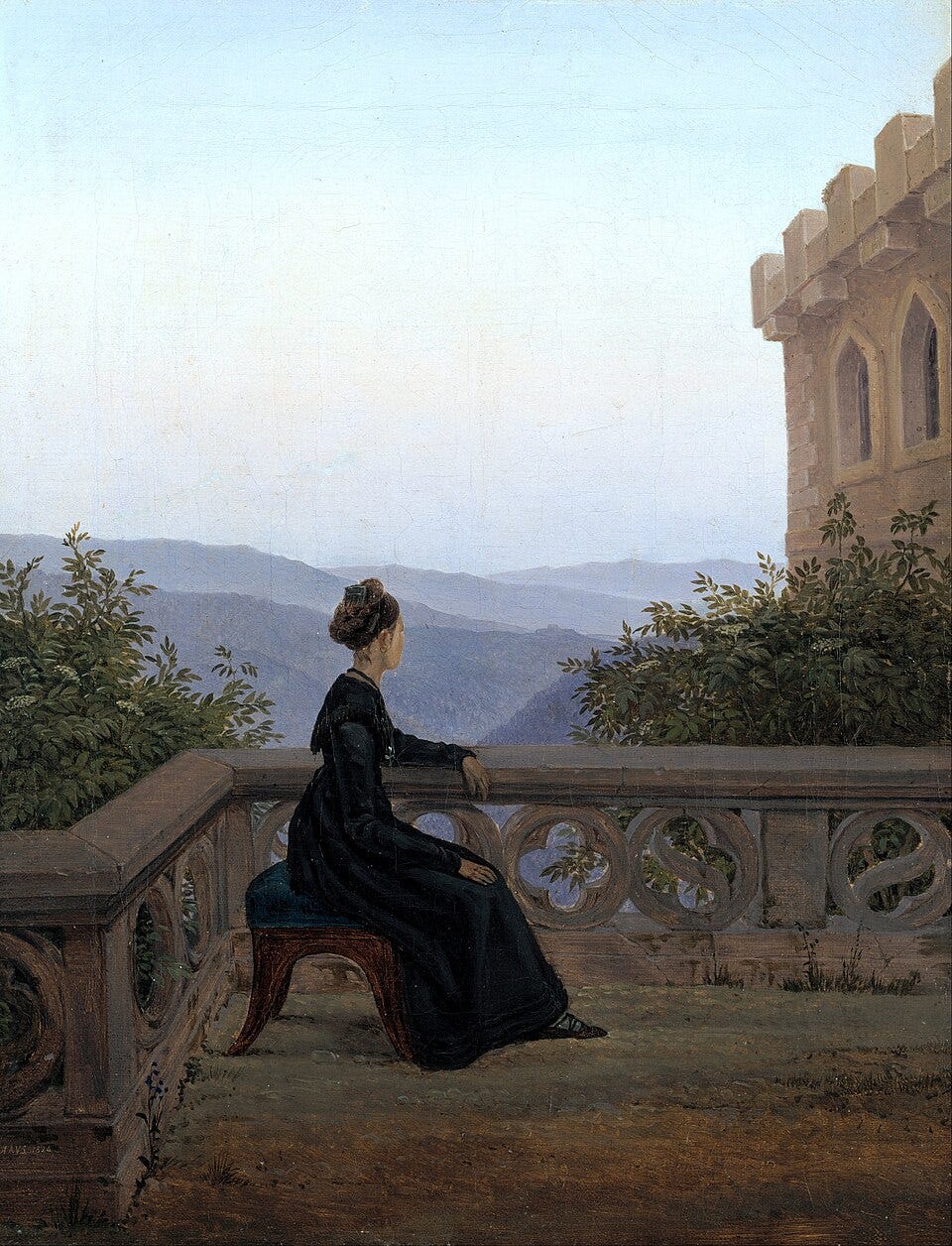
Many novels that became the foundation of the Gothic genre reached into the past, pre-Enlightenment, to incorporate supernatural events and characters who would believe them. Of course, plenty of Gothic novels reified the Enlightenment with a Scooby-Doo unmasking,1 but plenty did not. The Gothic novel is a resoundingly English genre that looks to a continental European, Roman Catholic past for its terror and mystery.
Where else would I begin with the Gothic genre than with Jane Austen’s beloved The Mysteries of Udolpho? Published in 1794, this novel by Ann Radcliffe whirls the reader to 1500s France, Italy, and more. I expected to find cobwebby castles, loose floorboards, dark caves, and mysterious figures. What I didn’t expect to find was a contemplation of nature as devotion, a cozy book that made me feel like a clergyman’s adolescent daughter reading by the fireside.

From the first chapter, one word grabbed my attention with the thrill of a ghostly hand: sublime. Sublime and sublimity appear 50 times in The Mysteries of Udolpho. Most frequently, Radcliffe uses “sublime” as an adjective: “Belonging to or designating the highest sphere of thought, existence, or human activity; intellectually or spiritually elevated.”2 Her use of “sublime” as a noun is tightly related to this definition. In Radcliffe’s day, the philosophical inquiry into aesthetics—essentially, anything that is understood through sensory perception—was growing in Germany. The English Romantics were preoccupied with natural beauty, and like the philosophers questioned the difference between viewing the power of a natural landscape, created by God, and a work of art created by human hands.
“A Well-Informed Mind”
In the first chapter, we see the generous, affectionate father St Aubert counseling his daughter Emily to train her mind:
“A well-informed mind,” he would say, “is the best security against the contagion of folly and of vice. The vacant mind is ever on the watch for relief, and ready to plunge into error, to escape from the languor of idleness. Store it with ideas, teach it the pleasure of thinking; and the temptations of the world without, will be counteracted by the gratifications derived from the world within. Thought, and cultivation, are necessary equally to the happiness of a country and a city life; in the first they prevent the uneasy sensations of indolence, and afford a sublime pleasure in the taste they create for the beautiful, and the grand; in the latter, they make dissipation less an object of necessity, and consequently of interest.” (Vol. 1, Ch. 1)
In Udolpho, Emily is beset with a variety of problems: “deep play” (gambling), smuggling, whether to tell the truth (and not being believed when she does); forced marriage; choosing material comforts over long-term safety. Yet, because she has been trained in “the pleasure of thinking,” Emily is not easily persuaded away from her aspirations. She has a rich inner life that gives her a wide-ranging existence even when confined in a remote castle. Her moral backbone does not bow to those who wish her ill. They are numerous, this being a Gothic novel.
Radcliffe was writing in a time when few men attended university, and higher education was a long-distant dream for women. Instead, Emily has a room in which she keeps “her books, her drawings, her musical instruments, with some favourite birds and plants. Here she usually exercised herself in elegant arts, cultivated only because they were congenial to her taste, and in which native genius, assisted by the instructions of Monsieur and Madame St. Aubert, made her an early proficient.” (Vol. 1, Ch. 1) Emily grows in knowledge of history, literature, poetry, art, music, botany, and more. Her well-informed mind becomes a crucial part of her romance later on.
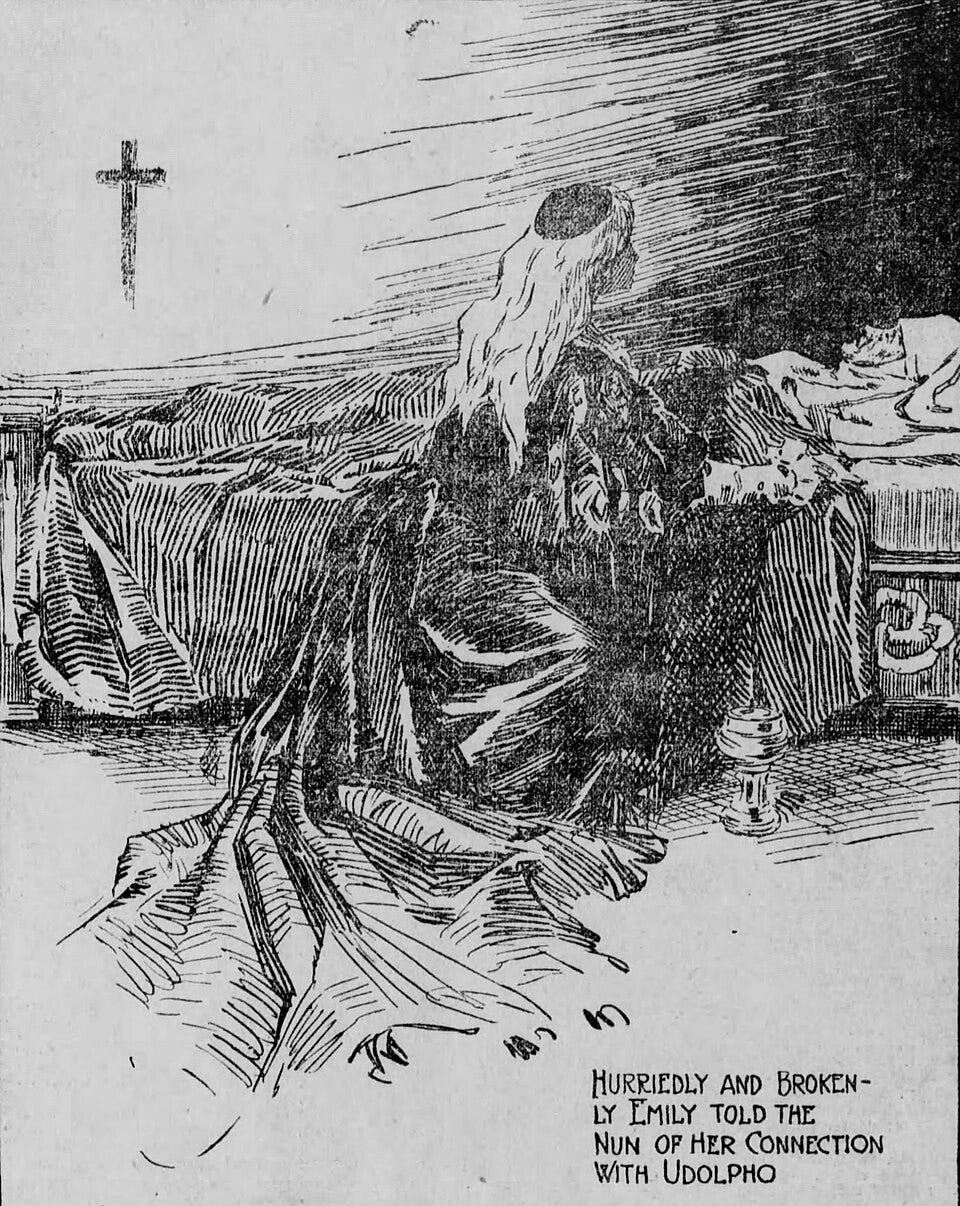
In the fourth chapter, Emily is on a trip with her father, and they take rest in a monastery. Unable to sleep, she responds to the sublime with all the wonder of the Psalmist:
It was a still and beautiful night, the sky was unobscured by any cloud, and scarce a leaf of the woods beneath trembled in the air. As she listened, the mid-night hymn of the monks rose softly from a chapel, that stood on the lower cliffs, an holy strain, that seemed to ascend through the silence of night to heaven, and her thoughts ascended with it. From the consideration of His works, her mind arose to the adoration of the Deity, in His goodness and power; wherever she turned her view, whether on the sleeping earth, or to the vast regions of space, glowing with worlds beyond the reach of human thought, the sublimity of God, and the majesty of His presence appeared. Her eyes were filled with tears of awful love and admiration; and she felt that pure devotion, superior to all the distinctions of human system, which lifts the soul above this world, and seems to expand it into a nobler nature; such devotion as can, perhaps, only be experience, when the mind, rescued, for a moment, from the humbleness of earthly considerations, aspires to contemplate His power in the sublimity of His works, and His goodness in the infinity of His blessings. (Vol. 1, Ch. 4)

Sublimity is awe-inspiring, a response to grandeur and magnificence. Yet, Radcliffe takes Emily’s experiences of the sublime in a different direction. When she is lonely and friendless in a cruel Gothic world, the sublime provides her with comfort, devotion, and emotional sustenance for her arduous journey. After the experience quoted above, Emily sinks “into a tranquil slumber.” The experience of the sublime, sometimes mediated through her spirituality, consoles Emily.
Sight and sound are the most consistent form of sensory perception in The Mysteries of Udolpho. Emily beholds sublime vistas and is transported by mysterious music (could it be the music of the spheres?3). Her senses of taste, touch, and smell are less frequently required. Emily is often ensconced in a room with a window showing a mountain view, and the mysterious music follows her through her travels. Like the biblical Samuel, she is responsive to these invitations for her eyes and ears to be transported to the sublime. Radcliffe’s wonderfully evocative writing invites the reader to attend to sublimity in her novel, but also to expand one’s sense of the sublime.4
Conclusion
I have hardly touched on the many twists and turns of the plot of The Mysteries of Udolpho, quoting mostly from the early chapters to show how Radcliffe sets up sublimity for the rest of her romance. I leave Udolpho and its actual mysteries for your perusal. It had a twist I never saw coming, though I am an incorrigible twist-guesser! While the eighteenth century is not often my favorite, I greatly enjoyed this 1794 novel and would read it again. I am already itching to re-read Northanger Abbey yet again to understand the intertextuality (why doesn’t Catherine Morland reach for the sublime like Eleanor Tilney instead of looking for a shock around every corner?).
This summer I have traveled to sublime places (including the south of France, not far from Emily’s fictional home), and have more to visit. Thanks to Radcliffe, I notice more how viewing such vistas refines my taste for “the beautiful, and the grand.”5 Rather than leaving her desolate, Emily’s sublime experiences carry her through difficulties. The memory of the sublime—the “emotion recollected in tranquility”6—can sustain through “dissipation” and prompt “pure devotion.”
Radcliffe does not let sublime experiences remain isolated on mountaintops. Once over, they don’t awaken dissatisfaction or misery, because they are truly uplifting experiences, a step on the journey and not a jump with a consequent fall. Instead, the sublime diffuses into Emily’s interior life, tuning her to sublimity as to the music of the spheres.
I thank Alison Milbank for this insight. Alison Milbank, “What makes a Gothic novel Christian: From Dracula to Sarah Perry’s Melmoth,” presented at What Makes a Novel ‘Christian’?, Pusey House, 13 May 2026.
“Sublime,” adjective use 4, Oxford English Dictionary. See also noun use 1b.
See The Merchant of Venice, “This Is My Father’s World,” and many other sources for musica universalis.
Austen heroines show a taste for the sublime. See Elizabeth Bennet’s response to going to the Lake District in Pride and Prejudice: “what delight! what felicity! You give me fresh life and vigour. Adieu to disappointment and spleen. What are men to rocks and mountains? Oh, what hours of transport we shall spend!…We will know where we have gone—we will recollect what we have seen. Lakes, mountains, and rivers, shall not be jumbled together in our imaginations.” (Chapter 37) Of course, Elizabeth and the Gardiners only go as far as the Peak District, missing the Lakes. See also Natasha Duquette, “Contemplating Beauty: Jane Austen’s Women as Connoisseurs,” Persuasions 43 (2021).
Though I must add I also seek the sublimity of the small. No sunrise is as beautiful as the one from my kitchen window! Yet, being away allows me to see the sublime in my everyday with fresh eyes.
William Wordsworth, “Preface” to Lyrical Ballads (1802), p. 111 in Wordsworth and Coleridge: Lyrical Ballads, 1798 and 1802, ed. Fiona Stafford (Oxford World’s Classics, Oxford University Press, 2013).
I have never read any Radcliffe and this essay has convinced me that Udolpho needs to join my TBR!
A delightful read as ever, Melody!!! Thank you for this!