

The Unknown, Remembered Gate
Nostalgia and the Christian Journey in David Jones and T. S. Eliot


Dear readers,
I’m thrilled to welcome Sarah Coogan to Mirrored Longings today! I thoroughly enjoy her work and know you will too.
Sarah Coogan is a scholar of twentieth-century poetry and the author of Nostalgia and National Identity in the British and Irish Modernist Epic. She writes about the relationship between literature and faith, with special attention to British modernism, at Paths That Lead Home. You can learn more about her work at sarahcoogan.net.
I am a nostalgic person. This is an embarrassing admission for an academic to make. We’re supposed to be detached, rational, and too sophisticated to succumb to the temptation of sentimentality.
But nine years of higher education did not free me of my susceptibility to the rosy glow of childhood memories or impossible yearnings for the distant past. And that is, more or less, why I wrote my first book about nostalgia.
I’m not the only one prone to this slightly suspect emotion: nostalgia is everywhere nowadays. The film industry keeps itself afloat through endless franchises and reboots. Politicians on both sides of the aisle routinely appeal to nostalgia through their slogans and imagery.
As consumers and as citizens, we all have to reckon with the ways nostalgia can be used to manipulate our emotions and actions. If we happen to be Christians, we may have deeper, spiritual reasons for scrutinising these feelings.
The biblical narrative progresses from creation and fall to redemption. Many Christians understand their faith journeys in terms of a conversion story, defined by the contrast between a negative past before Christ and the brighter future made possible by the regeneration of the Spirit. They look back, not with pleasure, but with gratitude for escape from the bondage of sin. To long for the past is to risk becoming like Lot’s wife, destroyed by her glance back at Sodom, or the Israelites, longing for slavery in Egypt.
So in what sense can nostalgia play a role in the Christian life?
I could explore this question by drawing on the writings of C. S. Lewis, whose thoughts on longing have been of great help to me and to many other Christians. I’ve written a bit about them here.
But in this letter, I want to share with you two other writers who have helped me to understand the role nostalgia can play in the Christian journey: T. S. Eliot (1888–1965) and David Jones (1895–1974).
Both Eliot and Jones have their own suspicions of nostalgia, questioning the utility of, as Eliot puts it, “Disturbing the dust on a bowl of rose-leaves.” Yet both draw on nostalgia to understand their personal experiences and their historical moment. Eliot’s and Jones’ poetry illuminates the central role nostalgia can play in motivating Christians to search for God’s presence in history and to wait expectantly for His return.
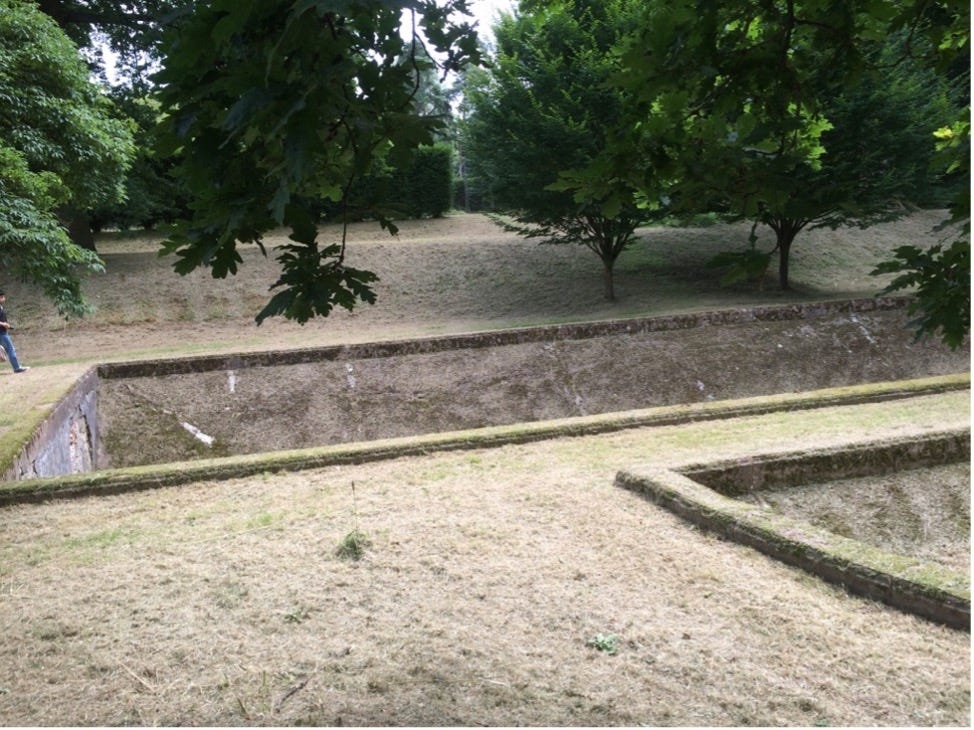
In 1934, T. S. Eliot visited an English manor house called Burnt Norton with Emily Hale, a longtime friend whom he loved but never married. In 1936, he published a poem reflecting on the visit, which became the first part of his great poetic sequence Four Quartets (1943). (You can listen to a reading of the whole sequence at the link above.)
In “Burnt Norton,” Eliot portrays wandering through the manor’s rose garden as an experience of transcendence, what he comes to call later in Four Quartets a ‘timeless moment.’ He has the sense of stumbling back into Eden, “Into our first world,” reclaiming for that brief moment his childhood innocence. The poem recalls the experience with vivid detail and a profound sense of longing. One might even say that Eliot is nostalgic for this luminous day, with its natural beauty and moment of spiritual communion with Hale.
His nostalgia proves conflicted, however. Even before describing that moment in the garden, “Burnt Norton’s” speaker asks, “But to what purpose / Disturbing the dust on a bowl of rose-leaves / I do not know.” The speaker is quickly driven out of the Edenic moment: “Go, go, go, said the bird: human kind / Cannot bear very much reality.” Yet Eliot’s recollections are not simply dismissed. He leaves us with a vivid description of this timeless moment, which may arouse our own longing.
In “Burnt Norton,” we experience a fall, ejected from a garden paradise into the mundane world. So we begin Four Quartets infected with a fragile nostalgia for paradise, for the long sunny days of the happy past.
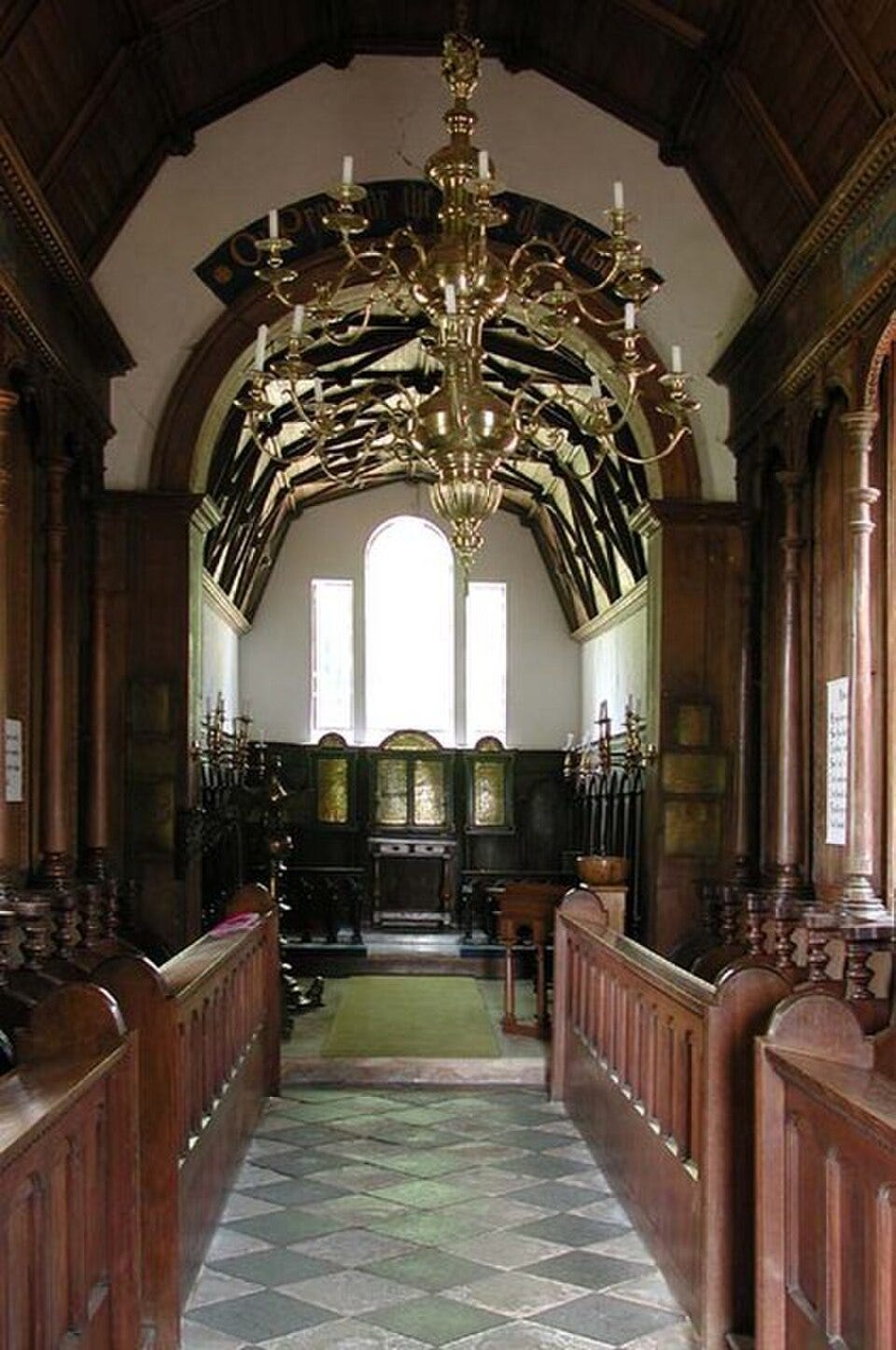
In the beginning of “Little Gidding,” the last of the Four Quartets, we glimpse another timeless moment of personal significance to Eliot. The poem is named after a manor house near Cambridge, where in the seventeenth century a community of lay Christians lived and worshipped together. The community is most famous because its leader, Nicholas Ferrar, was a dear friend of the poet and Anglican priest George Herbert, and Ferrar was responsible for publishing Herbert’s only volume of poetry, The Temple.
Eliot loved seventeenth-century literature, and so I’m certain when he walked the lane to Little Gidding and knelt in its tiny chapel, he thought of Herbert. But more broadly, he thought of the sanctity and fellowship of the community who lived there long before his visit.
The poem’s opening section is, in essence, a caution and guide for visitors. Eliot writes:
…You are not here to verify,
Instruct yourself, or inform curiosity
Or carry report. You are here to kneel
Where prayer has been valid….

Here, the intersection of the timeless moment
Is England and nowhere. Never and always.
Eliot visited Little Gidding in springtime, on the 25th of May 1936, but in the poem he describes visiting in midwinter, “In the dark time of the year.” And when he wrote about his visit, the days felt dark.
“Little Gidding” was published in October of 1942, in the midst of the Second World War. In 1942, it seemed likely that Britain would lose the war. Against that backdrop, the poet’s memory of kneeling in a quiet chapel in the British countryside appears both hopeful and mournful. In the chapel at Little Gidding, Eliot’s personal experience meets his sense of God’s intervention in history.
The poem goes on to depict the horrors of the Blitz, the struggle to perceive God’s hand at work in human suffering. So why does Eliot begin his poem’s theodicy, not with embattled London but with a moment of solitary prayer at Little Gidding? And what does all this have to do with nostalgia?
The final lines of Little Gidding point us towards an answer:
We shall not cease from exploration
And the end of all our exploring
Will be to arrive where we started
And know the place for the first time.
Through the unknown, remembered gate
When the last of earth left to discover
Is that which was the beginning;

…Quick now, here, now, always—
A condition of complete simplicity
(Costing not less than everything)
And all shall be well and
All manner of thing shall be well
When the tongues of flame are in-folded
Into the crowned knot of fire
And the fire and the rose are one.
This passage returns us to the garden—both identical to and distinct from the garden of Burnt Norton. We have explored the world, endured the struggles of human life, and we find ourselves at the unknown, remembered gate—the gate of Eden where we have never lived, the gate of the rose garden more beautiful in our memory than it ever was in reality.
And here again, the symbol of the rose appears in a new form. This is neither the transient garden rose, nor the dusty rose of human memory. It has been transformed into a divine symbol—Dante’s celestial rose, his image for heaven.
“And the fire and the rose are one,” Eliot tells us. All the sufferings of history at last find their meaning in eternity, as humans experience their final cause, their ultimate purpose, in beholding the beauty of God.
The symbol of the rose draws us both backwards and forwards in time. By transforming the rose into an image of heaven, Eliot does not erase its connection to the garden of Burnt Norton. Rather, he places that moment of spiritual insight into its proper context as part of a larger pattern of divine presence and intention. As he claims in “Little Gidding,” “history is a pattern / of timeless moments.”
Nostalgia for Burnt Norton’s garden drives the speaker to look back at that remembered moment, but it equally motivates him to look forward, to where the Christian journey finds its fulfillment at “the unknown, remembered gate” of the New Jerusalem. So in Eliot’s work, nostalgia offers a way to connect personal memory with God’s larger historical purpose.

If Four Quartets responds to the particular fears of wartime, David Jones’ work reacts to the sense of disorientation and loss that can accompany our experience of modernity.
Jones is perhaps better known for his painting and engraving than for his poetry. He was born in London and lived there the most of his life, but he strongly identified with his parents’ Welsh heritage and therefore always felt somewhat displaced. He wrote two great long poems: In Parenthesis (1937) and The Anathemata (1952). (I’ve written about In Parenthesis here and about Jones’ theory of culture here, if you want to know more.)
Here, though, I want to focus on one of his few lyric poems, “A, a, a, Domine Deus,” which he drafted in 1938 and revised repeatedly until 1966. The poem is his artistic manifesto, an expression of his struggle to belong in the modern world and his constant search for the presence of the Lord. It is at once a lament and a declaration of hope.
“A, a, a, Domine Deus” describes this search for home as, at its heart, a search for God. The poem begins: “I said, Ah! What shall I write? / I enquired up and down. // (He’s tricked me before / with his manifold lurking-places.)”
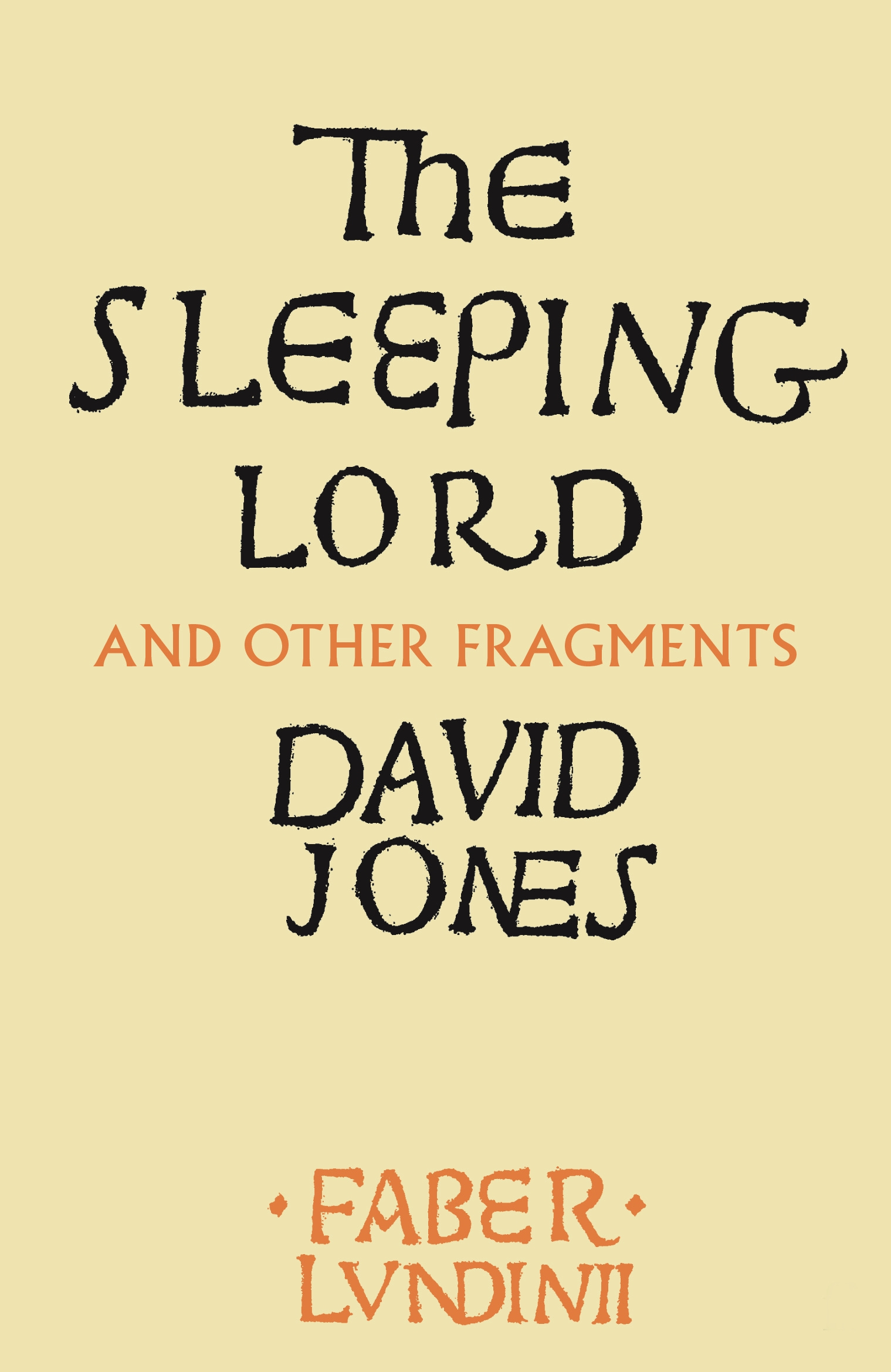
“He” in this context refers to God. The poet proceeds to search the landscape of the modern city for the presence of the Lord, examining “nozzles and containers,” “automatic devices,” and other unlikely places, “For it is easy to miss him / at the turn of a civilization.”
Yet in the conclusion, the speaker is forced to lament, “A, a, a, Domine Deus, my hands found the glazed work unrefined and the terrible crystal a stage-paste.” His search for God concludes with a sense of alienation and artificiality. In spite of this concluding lamentation, the poem contains a compelling urgency, a sense of the nobility of the poet’s quest, even when the process proves frustrating and apparently unsuccessful.
“A, a, a, Domine Deus” reflects Jones’ belief that art and faith are inextricably entwined. The speaker searches for what to write, and that entails searching for God. For Jones, a devout Roman Catholic, making art is essentially inseparable from religious practice. Both writing a poem and celebrating the Mass involve “anamnesis,” a theological concept derived from a Greek word usually translated as “remembrance.” When Christ presides over the Last Supper, he commands his disciples “Do this in anamnēsis of me.” Such active remembrance makes the past present once more.
Jones believes that this is the case for both art and worship. Both make the past present. Art re-presents an object under a new form. Worship recalls God’s work in the past as a way of experiencing His presence. As the eminent Jones scholar Thomas Dilworth puts it in The Shape of Meaning in the Poetry of David Jones, “the consecration of the Mass annihilates time.”
But this sort of complicated relationship with time is relevant for all Christians, not just those who affirm transubstantiation. Christianity is a religion of multiple and paradoxical temporalities. Christ indwells his followers, yet his followers await his return. The Kingdom of God is within you; the Kingdom of God is yet to come.
This duality is often formulated as the “Already/Not Yet”, a concept derived from the work of Calvinist theologian Geerhardus Vos. Believers are already saved, indwelt by the spirit, united with Christ. And yet we inhabit a fallen world, remaining aware of our sin and distance from God, and we long for Christ’s return. Christian life, especially as embodied in communal worship, must make space for an awareness of hiddenness and longing, of the revelation of Christ not yet complete.
Christians are, in effect, nostalgic for the future, even as we seek God’s presence in our lives on earth. The collapsed temporality of Christian worship—already and not yet—temporarily resolves this longing for the future, as the eschaton breaks in on the mundane meeting of the faithful. Yet it may also amplify this longing, as the experience of Christ among his worshipping people makes us long for his appearing under the form of human flesh and blood.
T. S. Eliot and David Jones are suspicious of sentimentality about the past, yet their poetry points us to the role that nostalgia can play in the Christian’s search for God’s presence. Both experience the home-longing of the believer looking for God in the chaos of the world around them. As poets, their wait for God becomes entwined with their struggle with language. As Eliot declares in the conclusion of “Little Gidding”:
Every phrase and every sentence is an end and a beginning,
Every poem an epitaph. And any action
Is a step to the block, to the fire, down the sea’s throat
Or to an illegible stone: and that is where we start.
Just as “A, a, a, Domine Deus” begins with Jones’ search for something to write, Eliot’s struggle with language goes hand in hand with the quest for God’s presence and purpose in the world.
Jones and Eliot hold theological hope in tension with their perception of decline, fragmentation, historical lateness. To me, that is not problematic doubt. Rather, it is an acceptance of discomfort that drives the continued search for God.
Nostalgia, in these texts, is both a painful longing for union with Christ and a resolute hope in God’s redemptive purpose. It’s the voice that whispers between the poetic lines, calling the reader to look homeward—to “the unknown, remembered gate” that awaits us.
 | A guest post by
|